




Audio By Vocalize

Kenya’s macadamia industry is expanding at an impressive pace, but beneath the growth statistics lies an increasingly uneasy harvest season that has exposed structural weaknesses and policy gaps threatening the sector’s future.
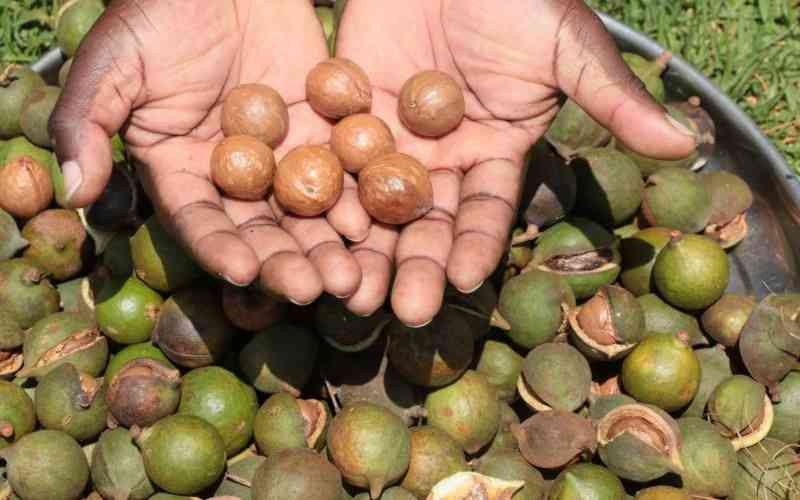
The controversy centres on the timing of the 2026 harvesting window gazetted by the Agriculture and Food Authority (AFA). Before reopening harvesting and trading effective February 1, 2026, AFA’s own surveillance revealed uneven maturity levels across agro-ecological zones.
“Most nuts in lower-altitude coffee-growing zones had attained physiological maturity, with some mature nuts naturally dropping to the ground,” the Authority noted in its findings. “In contrast, nuts in higher-altitude tea-growing zones were largely immature.”
Despite acknowledging this variation, AFA reopened the window and urged farmers to harvest only mature nuts. That decision has triggered sharp debate across the value chain.
“Processors and farmers are now asking why the opening date wasn’t adjusted, especially when surveillance had already shown that nuts in some regions were far from mature. Traditionally, we wait for macadamias to fall naturally, the clearest sign of peak maturity and the best kernel quality,” a processor who sought anonymity said.
Charles Muigai, an industry expert and former Chief Executive Officer of the Nut Processors Association of Kenya (NutPAK), warns that premature harvesting risks eroding Kenya’s hard-earned reputation in global markets.
“When you open the window before uniform maturity, you distort the entire value chain,” Muigai says. “Quality is Kenya’s competitive advantage. Once that is compromised, recovery rates drop, processors struggle, and export credibility suffers.”
According to Muigai, more than 60 per cent of nuts currently delivered to processors fail to meet global quality standards. Only about 10 percent qualify as premium grade, fetching up to US$11 per kilo in export markets. The rest are small or unsound kernels.
The story becomes even more stark when we consider the kernel recovery rates. Kenyan processors require nearly eight kilos of raw nuts, according to Muigai, to produce just one kilo of export-ready kernel, a ratio considered uncompetitive by global standards.
The absence of grading at the farm gate has compounded the problem. Although the government set a minimum farm-gate price of Sh100 per kilo, brokers are reportedly buying low-quality nuts at Sh50, mixing them with better produce and reselling at Sh110. The blending depresses overall quality and leaves processors unable to meet stringent international specifications.
European buyers, especially in the European Union, have very strict import requirements related to quality, maturity, and post‑harvest handling. Reports note that poor quality and inconsistent grading have previously led to rejections and concerns about Kenya’s produce, impacting demand and creating barriers to market access.
Jeremiah Maina Marete, a farmer from Meru, says the uniform harvesting window ignores regional climatic realities.
“In Meru, maturity varies by altitude and variety. Some orchards are ready; others are not. When the window opens nationally, farmers feel pressured to harvest everything,” he says.
In Murang’a, Hilary Gachanja echoes similar concerns. “If we harvest immature nuts, we lose weight, we lose quality, and in the long run, we lose markets. The policy must protect the farmer, not expose us to losses,” he says.
Ironically, the quality concerns emerge at a time when acreage and output are expanding. According to AFA’s Yearbook of Statistics of 2024, land under macadamia increased from 7,120 hectares in 2019 to 9,336 hectares in 2024, while production rose from 39,815 metric tonnes to 49,183 metric tonnes.
Stay informed. Subscribe to our newsletter
Counties such as Uasin Gishu, Taita Taveta and Busia are joining traditional strongholds Murang’a, Meru and Embu. Farm-gate prices surged nearly 69 per cent in 2024, lifting total earnings to Sh4.95 billion.
Yet analysts warn that growth without coordination may prove unsustainable.
Muigai notes that AFA has never conducted a comprehensive competitiveness study nor undertaken crop mapping or a national tree census to establish accurate production data.
“We are expanding blindly,” he says. “There is no industry development policy, no structured funding mechanism, and licensing remains poorly regulated. If the current fragmentation persists, very few processors will break even by 2030.”
The industry’s institutional framework has also weakened. Following the 2009 ban on raw nut exports, processors established the Nut Processors Association of Kenya to mobilise farmers and promote the establishment of new orchards. Today, the association is largely moribund.
Kenya supplies nearly 20 percent of global macadamia demand and supports over 200,000 smallholder farmers. But stakeholders say the current harvest controversy signals deeper governance challenges.
Without region-specific harvesting windows, proper grading systems, reliable production data and a clear industry policy, Kenya’s macadamia boom could easily morph into a quality crisis.