

Audio By Vocalize

The Russian Embassy in Nairobi has dismissed as “dangerous and misleading propaganda” allegations that it recruited Kenyan citizens to fight in its war against Ukraine.
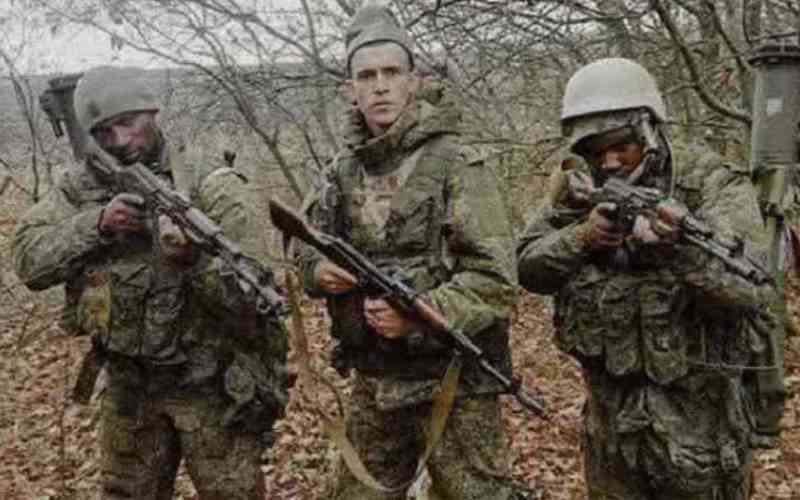
The denial, issued on Thursday, February 19, came a day after a National Intelligence Service (NIS) report told parliament that more than 1,000 Kenyans had been funnelled into the Russian military through a web of rogue state officials and fake job offers, with 89 currently on the front line, 39 hospitalised, 35 in military camps, 28 missing and at least one confirmed dead.
“The Embassy refutes such allegations in the strongest possible terms. The Government authorities of Russia have never engaged in illegal recruitment of Kenyan citizens in the Armed Forces of the Russian Federation,” the embassy said in a statement.
The embassy noted it had not issued visas to Kenyans for the purpose of joining Russia’s military operations in Ukraine, nor had it encouraged any citizen to do so or colluded with individuals to lure Kenyans into combat.
Yet in the same breath, the embassy confirmed that Russian law does not bar foreign nationals from voluntarily enlisting in its armed forces, provided they are legally in the country, a caveat that critics say has become the legal cover for an elaborate deception pipeline.
Majority Leader Kimani Ichung’wah, who presented the NIS report to the National Assembly on Wednesday, alleged that rogue staff at the Russian Embassy in Nairobi and the Kenyan Embassy in Moscow were among those issuing recruits with Russian visit visas.
“Our embassy must be beyond reproach. It must be the place where Kenyans can seek refuge, not exploitation,” Ichung’wah told parliament.
The story of how Kenyans ended up in one of the world’s bloodiest conflicts begins not in Moscow but in Nairobi’s job markets and in places as far away as Qatar, Dubai and Saudi Arabia, where Kenyans already working abroad were targeted.
Interior Cabinet Secretary Kipchumba Murkomen told the House on Wednesday how the pipeline works.
“Some are even recruited in the Middle East. They are already doing normal security work, private security work, and then they are picked, taken to Russia, taken through push-ups for two days or so, given a gun for the first time in their life, and then they are put on the front line. It is a very, very painful situation,” noted Murkomen.
The NIS report names Global Face Human Resources Limited, a firm on Koinange Street, Nairobi, owned by one Festus Omwamba, as one of the active recruitment outfits.
The agency, registered in 2024 and not accredited by the National Employment Authority, used the government’s ‘kazi majuu’ jobs abroad initiative to present itself as a legitimate, state-endorsed employer.
Recruits were promised monthly salaries of up to Sh350,000, bonuses between Sh900,000 and Sh1.2 million and Russian citizenship.
Stay informed. Subscribe to our newsletter
Upon arrival in Russia, many were taken to military camps and trained for as little as three weeks, sometimes just nine days for weapons and explosives, before being deployed to active combat.
Those who could not leave through Nairobi’s Jomo Kenyatta International Airport (JKIA) after increased interceptions were rerouted through Uganda, the Democratic Republic of Congo (DRC) and South Africa to avoid detection. Others left through Istanbul, Turkey and Abu Dhabi in the United Arab Emirates (UAE) on tourist visas.
The NIS report alleges that rogue airport staff from the Directorate of Immigration, the Directorate of Criminal Investigations (DCI), the Anti-Narcotics Unit and the NEA were all colluding to let recruits pass unchecked at JKIA.
A raid on a holding facility at Greatwall Apartments in Athi River in September unearthed 22 Kenyans, aged between 24 and 38, being held pending travel.
Investigators recovered 39 unsigned employment contracts, 16 passports and two mobile phones. A Russian national linked to Omwamba’s network was among those found at the facility.
This is not the first time Russia has denied a role in the crisis. In September, the embassy denied that Mikhail Lyapin, a Russian national questioned by the DCI over an alleged recruitment ring, was ever a government employee, saying he had been questioned about his private business activities before leaving Kenya.
Families of those stranded have grown increasingly desperate. On Thursday, relatives gathered at Jeevanjee Gardens in Nairobi to petition both the Russian Embassy and the government for urgent intervention, citing months of silence from their loved ones at the front.
Ukraine’s Foreign Minister Andrii Sybiha has previously estimated that at least 1,436 foreign nationals from 36 African countries are fighting for Russia, warning that the true number could be higher.
“Signing a contract is equivalent to signing a death sentence. Foreign citizens in the Russian army have a sad fate. Most of them are immediately sent to so-called ‘meat assaults,’ where they are quickly killed,” said Sybiha.
Foreign and Diaspora Affairs Cabinet Secretary Musalia Mudavadi, who told parliament he had shut down more than 600 recruitment agencies suspected of duping Kenyans with promises of overseas jobs, is scheduled to travel to Moscow in March to press Russia to sign a bilateral agreement barring the conscription of Kenyan nationals.
The talks will also seek the release of Kenyans held as prisoners of war in Ukraine.
The Russian Embassy noted that several bilateral draft agreements on labour migration, travel and security coordination had been under consideration by Kenyan authorities for years and called for their soonest finalisation.
“This is a chilling matter. We are so vulnerable to the extent that we are unable to manage this situation. The DCI and the NIS need to move with swiftness and deal with these rogue agencies,” noted Ichung’wah.