



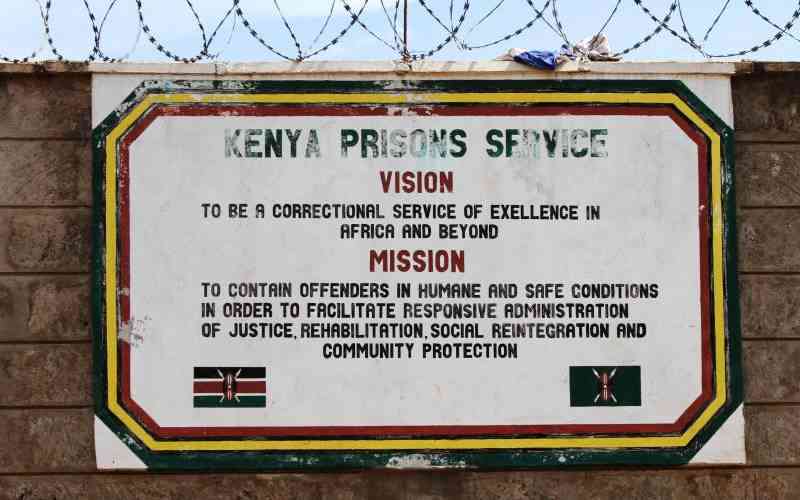
Kenya Prisons Service officers solicited millions of shillings in bribes to facilitate recruitment, the Commission on Administrative Justice (Ombudsman) has revealed.
Some victims paid as much as Sh990,000 to officers who promised them jobs in the service.
The Ombudsman uncovered extensive corruption after receiving 17 complaints, 12 of which were corruption-related, involving officers demanding money in exchange for deployment or official favours.
Several implicated officers acknowledged receiving the bribes and refunded partial or full amounts during internal inquiries.
The findings stem from a review of performance contracting returns for quarter two of 2025/2026, the commission announced in a statement.
In one case, a Chief Inspector and a sergeant allegedly received Sh600,000 to facilitate the recruitment of an individual into the service.
After the Ombudsman intervened, the two refunded Sh500,000 but remain liable for the outstanding Sh100,000 balance.
Another prison officer received Sh870,000 for the same purpose and agreed to pay it back.
A Kenyan who was promised recruitment paid Sh450,000, but the promise never materialised. After complaining to the Ombudsman, they recovered Sh200,000 and the corporal who took the money committed to paying the balance.
An officer from the Ethics and Anti-Corruption Commission (EACC) complained to the Ombudsman after a recruitment promise into the prison service was not honoured despite paying Sh800,000.
The Senior Superintendent admitted receiving the money and repaid Sh700,000, with the balance still outstanding.
A Chief Inspector is accused of receiving Sh800,000 to facilitate recruitment, repaying only Sh400,000.
Three additional recruitment-related cases involved prison service officers. One received Sh600,000 and admitted the same, saying they had repaid Sh450,000 with a Sh150,000 balance remaining.
In the second case, the officer admitted receiving Sh990,000 and had repaid Sh360,000, leaving a Sh630,000 balance which they were to pay by 18 January 2026.
Stay informed. Subscribe to our newsletter
In the last case, an officer allegedly received Sh371,150 and admitted liability once summoned by the Ombudsman.
Two people within the Kenya Defence Forces (KDF) are under the radar of the Directorate of Criminal Investigations (DCI) after they allegedly received Sh3 million and Sh800,000, respectively.
The Sh3 million was intended to facilitate the employment of four men within the KDF, while the Sh800,000 was to assist the complainant’s wife in securing employment.
The commission noted that all cases fall under the Ethics and Anti-Corruption Commission’s (EACC) mandate to investigate and forwarded the complaints to EACC CEO Abdi Mohamud for action within 60 days.
“Some officers admitted to having received monies and committed to full refunds through negotiated arrangements; however, such arrangements do not remove criminal or administrative liability,” the Ombudsman said.
Officers who did not admit to taking bribes should be investigated by the Ethics and Anti-Corruption Commission (EACC), and where culpability is established, action should be taken according to the law, the office added.
The Ombudsman wrote to the Principal Secretary of the State Department for Correctional Services, Salome Wairimu, to initiate administrative action.
They also want the PS to summarily dismiss prison service officers who admitted to taking bribes.
The Ombudsman directed Inspector General of Police Douglas Kanja to oversee an investigation into the corruption allegations within 60 days.
“The Commission has therefore written to the Inspector General of Police and has referred the names of individuals who offered or paid bribes to the Directorate of Criminal Investigation (DCI) under the IG’s supervision for urgent investigation,” the Ombudsman said.
Police Spokesperson Muchiri Nyaga noted that the National Police Service will follow strict due process in dealing with the complaints.
“Corruption, misconduct or breaches of the law in whatever form or shape shall be dealt with as guided by the law and regulations,” said Nyaga.
The Ethics and Anti-Corruption Commission (EACC) through spokesperson Stephen Karuga confirmed it received the letter and will consider the request to take appropriate action.