

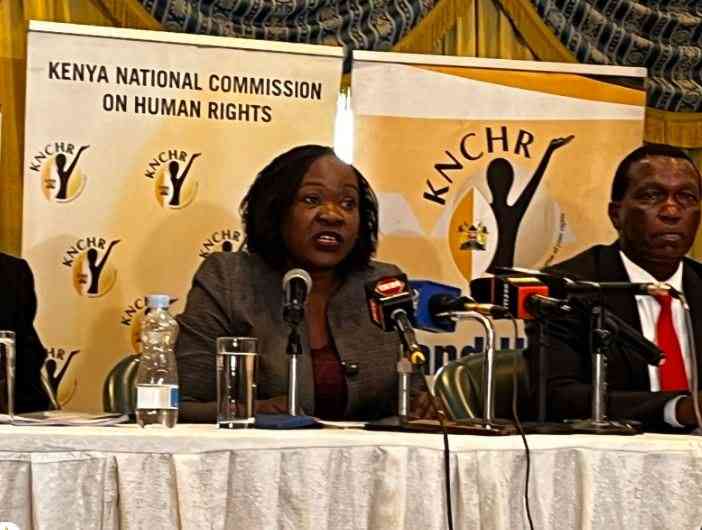
The Kenya National Commission on Human Rights (KNCHR) has called for the urgent implementation of legal and policy remedies to address persistent human rights violations facing intersex persons in Kenya.
In its State of Human Rights Report for the period December 2024 to December 2025, the Commission urged Parliament to fast-track the Intersex Persons Bill, 2024, saying the proposed law is critical to securing legal recognition and protecting bodily integrity.
“Fast-tracking the Intersex Persons Bill, 2024 is essential to introduce legal recognition and affirm the right to self-determination,” said KNCHR Chairperson Claris Ogangah.
The Commission also called on the Ministry of Health to urgently develop comprehensive medical guidelines to protect intersex persons from harmful and non-consensual medical interventions.
“Clear medical guidelines are necessary to safeguard bodily integrity and guarantee access to inclusive, non-discriminatory healthcare for intersex persons,” Ogangah said.
KNCHR stressed that legal reforms must be accompanied by the meaningful participation of intersex people in decision-making.
“Intersex voices must be integrated in policy and law-making processes if these interventions are to respond to real lived experiences,” the Chairperson noted.
The Commission further urged the strengthening of access to justice, noting that many intersex persons are unable to assert their rights due to stigma, lack of awareness and institutional barriers.
“Access to justice remains limited, making it difficult for intersex persons to report violations and seek redress,” Ogangah stated.
In the report, KNCHR observed that intersex persons continue to face exclusion arising from rigid sex registration systems, social stigma and legal gaps, which deny them equal participation in society.
The Commission said these challenges violate constitutional guarantees of equality and non-discrimination.
The Commission also emphasized the need for sustained public education to address widespread misconceptions about intersex variations.
“Public awareness and education are key to reducing stigma and fostering understanding across all sectors,” Ogangah said.
KNCHR called on the Government, Parliament and other stakeholders to act with urgency in implementing the recommended remedies.
Stay informed. Subscribe to our newsletter
“Addressing these gaps is not optional; it is a constitutional obligation to ensure that no one is left behind,” Ogangah said.