




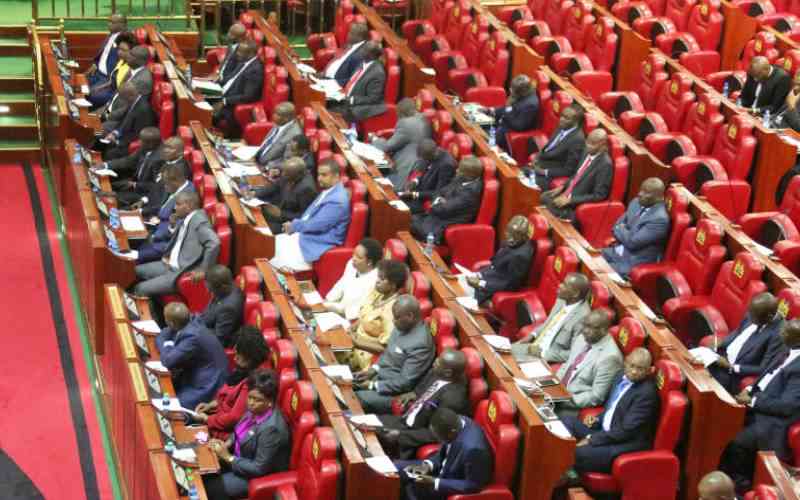
It is a big win for Members of Parliament after the Court of Appeal overturned a High Court ruling that had declared the National Government Constituencies Development Fund (NG-CDF) Act unconstitutional.
It has now allowed the Sh45 billion popular constituency kitty to continue operating.
In a judgment delivered on Friday by a three-judge bench comprising Justices Daniel Musinga (President of the Court of Appeal), Francis Tuiyott and Aggrey Muchelule, the appellate court set aside the September 2024 High Court decision, which declared NG-CDF illegal and ordered that the Fund cease operations by June 30, 2026.
The appellate court’s verdict is also a relief for millions of Kenyans who rely on NG-CDF-funded projects such as bursaries, school infrastructure, and community development initiatives, while also handing a significant reprieve to legislators who had faced uncertainty over the future of the fund.
The appellate court found that the High Court had erred in declaring the entire NG-CDF Act, 2015, as amended in 2022 and 2023, unconstitutional.
The judges ruled that the fund does not violate the principles of devolution, does not create a third tier of government, and operates within the constitutional framework.
“We find that the NGCDF Act, 2015 does not interfere with the functions of county governments and does not offend the principle of devolution,” the court stated in its comprehensive 63-page judgment.
The appeals were filed by the National Assembly and the National Government Constituencies Development Fund Board following the High Court’s ruling in a petition brought by Wanjiru Gikonyo and Cornelius Oduor Opuot in 2016.
The Musinga-led bench also dismissed arguments that the Fund created a parallel government structure, ruling that constituencies serve as legitimate national government service delivery units.
The judges emphasized that the Constitution permits the national government to decentralise its services to lower administrative levels without violating devolution principles.
“The use of the constituency as the operative unit is neither novel nor extraneous to the constitutional order; it is a unit firmly embedded within the national governance framework,” they stated.
While the appellate court largely upheld the Fund’s governance structure, it found one provision problematic.
Section 43(9) of the Act, which ties the term of the Fund Account Manager to the term of Parliament, was declared unconstitutional for creating a perceived link between the Fund’s administration and the political tenure of MPs.
Stay informed. Subscribe to our newsletter
However, the court severed only this specific provision rather than invalidating the entire Act, stating that its removal does not impair the coherence or operation of the Act.
Further, the three judges rejected claims that the Act’s enactment without Senate concurrence was unconstitutional.
Citing a recent Supreme Court decision, the judges noted that Section 24 of the Act restricts the Fund to exclusive national government functions, meaning it does not affect county governments and therefore did not require Senate approval.
Musinga, Tuiyott and Muchelule also found no evidence of the duplication of projects or wastage of resources that the High Court had warned about.
The judges noted that neither the Council of Governors nor the Senate, both parties to the case, had raised complaints about actual duplication or conflicts during the Fund’s years of operation.
The NG-CDF has had a tumultuous legal history. The original Constituencies Development Fund Act of 2013 was declared unconstitutional by the Supreme Court in 2022 in the Institute for Social Accountability case, which found that it violated separation of powers and devolution principles.
Parliament then enacted the NG-CDF Act, 2015, which was subsequently amended in 2022 and 2023 to address the constitutional concerns raised by the courts, including removing MPs from direct management of the Fund.
Despite these amendments, the petitioners challenged the Act before the High Court, which in September 2024 declared it unconstitutional and gave it until June 30, 2026, to wind down operations.
But, the appellate judges were critical of the High Court’s approach, noting that it had relied heavily on the Supreme Court’s 2022 decision concerning the repealed 2013 Act without adequately analyzing the substantially different 2015 Act and its amendments.
“The High Court had placed undue reliance on the Supreme Court’s decision in Institute of Social Accountability which concerned the invalidation of the CDF Act, 2013. The governance architecture of the NGCDF Act, 2015 is materially different,” the Musinga-led bench observed.
The judges emphasised that under the amended Act, MPs neither sit on CDF Committees nor determine projects directly.
The Fund is administered by a Board under the Ministry of National Treasury and Economic Planning, with projects identified through community participation and implemented by project management committees.
The court found that the Fund operates within constitutional public finance principles.
Drawing 2.5% of the national government’s share of revenue after the vertical division between national and county governments, the Fund is subject to multiple layers of oversight including mandatory audits by the Auditor-General and scrutiny by the National Assembly.
“The allocation and utilization process is carefully structured,” the judges noted, adding that Section 24 of the Act expressly confines funded projects to “works and services falling within the exclusive functions of the National Government.”
In reaching their decision, the judges emphasised that the Constitution does not require a rigid separation of powers but rather a functional system of checks and balances.
“The Constitution deliberately permits functional overlaps among the three arms of government,” they stated, citing examples such as parliamentary approval of presidential appointments and the Executive’s participation in legislative processes through presidential assent.
The judges also stressed the importance of the presumption of constitutionality for Acts of Parliament, placing the burden on challengers to demonstrate clear constitutional violations.
The decision means that NG-CDF operations will continue uninterrupted, providing relief to MPs who rely on the Fund for grassroots development projects in their constituencies.
The Fund supports projects in education, health, water, infrastructure, and other areas at the community level.
However, Parliament must now move swiftly to amend Section 43(9) to ensure the Fund Account Manager’s position is delinked from the political tenure of MPs, as directed by the court.
Dissatisfied with the decision, the petitioners, Gikonyo and Oduor, through lawyer Joshua Nyawa, immediately filed a notice to appeal to the Supreme Court.
“The 1st and 2nd Respondents herein, Wanjiru Gikonyo and Cornelius Oduor Opuot, being aggrieved by the entire judgment of Justices Musinga, Tuiyott, Muchelule in Civil Appeal No. E884 of 2024, as consolidated with E868 of 2024, delivered on February 6, 2026, intend to appeal to the Supreme Court against the entire judgment and orders,” the notice of appeal states in part.