


Audio By Vocalize

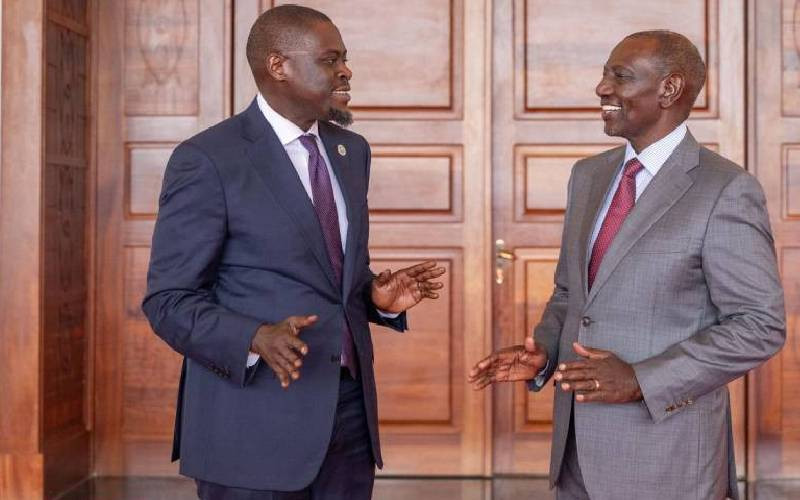
The High Court in Nairobi on Wednesday certified as urgent a case filed to challenge the co-operation deal to run the county between Nairobi County Governor Johnson Sakaja and President William Ruto.
Justice Bahati Mwamuye directed Benard Peter and Christine Gathoni to serve the court papers on Attorney General Dorcas Oduor, Prime Cabinet Secretary Musalia Mudavadi, Sakaja, the Nairobi County Assembly, and the Senate by Friday, after which they are expected to respond within seven days.
In this case, Peter and Gathoni argued that the deal signed on 17 February between the county chief and the national government was illegal and a violation of devolution.
https://www.youtube.com/watch?v=dLac3YpUphs
Their lawyer, Ibrahim Anyinyo, said the billions committed for Nairobi regeneration and works will be spent outside the devolution structure and violate the oversight channels provided in law.
According to him, the county assembly has not approved the amount claimed to have been set aside for the projects, while, at the same time, the Senate has no powers to oversee money spent by the Presidency.
He was of the view that the creation of a co-authority to run the capital city was an illegal alteration of the functions set for the two levels of government.
“Continued implementation risks altering the constitutional allocation of functions between the two levels of government before this honourable court has pronounced itself on the legality of the impugned arrangement,” argued Anyinyo.
The lawyer said the steering committee set up to implement the deal is not recognised under the law. He was of the view that although it did not transfer county functions to the Executive, it created an avenue for officials to run and/or control activities and functions exclusively set for the counties.
According to him, Sakaja ought to have thrown in the towel formally and allowed the Constitution to take effect, instead of allegedly sidestepping Article 187.
“The Agreement creates oversight and implementation frameworks that substantially reconfigure operational control over devolved functions. Article 187 requires formal transfer arrangements with constitutional safeguards, which were not invoked,” he added.
Anyinyo also told the court that the agreement was concluded without public participation. He further said that it only provided for Nairobians to give their views on the projects to be undertaken under the joint venture.
According to the lawyer, the President and the Governor put the cart before the horse, as the law requires them to seek public views before creating new or restructuring the current governing model.
He asserted that there is no evidence to show that public forums were conducted, or that notices, memoranda, or participation reports were issued before execution.
“The Agreement therefore violates Articles 10 and 174(c) of the Constitution,” he said.
Stay informed. Subscribe to our newsletter
Anyinyo also faulted Sakaja, saying he allegedly committed Nairobi County to financial obligations without debate and approval by the county assembly. He argued that the law requires the county to scrutinise the money set aside for projects and give the green light before spending. However, according to him, this was not done.
“The governor cannot unilaterally bind the County Government to structural and fiscal commitments without legislative oversight. The execution of the Agreement without County Assembly involvement violates the Constitution and undermines separation of powers at the county level,” the lawyer argued.
He also claimed that Sakaja undermined the Senate as he never presented or submitted the document for the Upper House’s concurrence.
He asserted that failure to involve the Senate rendered the document procedurally unconstitutional.
“The agreement creates oversight and implementation frameworks that substantially reconfigure operational control over devolved functions,” he claimed.
Peter and Gathoni want the court to find that the co-operation agreement violates the Constitution for failure to involve the Senate, the county assembly, and conduct public participation.
They also want the court to declare that the agreement undermines the structure of devolution and should be quashed.
Further, they are seeking an order barring the Governor, the President, and their associates or representatives from affecting the deal.
“The agreement establishes joint governance structures over devolved functions, including waste management, county roads, markets, housing, and water services. These are functions constitutionally assigned to County Governments under the Fourth Schedule,” said Peter.
The case will be heard on 16 March.