


Audio By Vocalize

A new initiative aimed at boosting the safety and capacity of human rights defenders in Kenya and across East Africa has been unveiled amid growing concerns over shrinking civic space and rising threats against activists.
The proposed “Haki Village,” a flagship project by the National Coalition of Human Rights Defenders, will be a resource hub designed to provide protection, training and long-term support to individuals working to advance justice and accountability across the country.
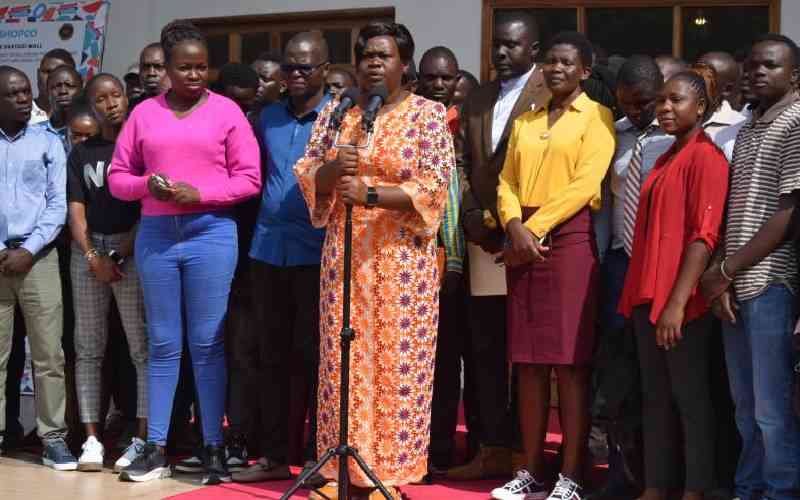
Speaking during the launch of the Coalition’s 2026–2030 strategic plan, Executive Director Kamau Ngugi said the initiative is part of a broader push to ensure sustainability in supporting human rights defenders, many of whom operate under difficult and dangerous conditions.
“We believe that the defenders should have a home, and the level of support should not just be moving up and down depending on funding that comes. We believe in sustainability and our future focus is to be able to build Haki Village,” Kamau said.
He revealed that the organisation is already mobilising resources to bring the project to life, and nearly half of the required funding has been secured.
The proposed hub is envisioned as a self-sustaining space that will anchor long-term protection efforts, even as the coalition responds to immediate risks facing defenders.
Speaking at the launch, Kenya National Commission on Human Rights (KNCHR) chairperson Claris Ogangah, lauded the Haki Village initiative saying that human rights defenders are increasingly operating in a hostile environment marked by intimidation and attacks hence the need for protection.
“Across the world, and indeed here in Kenya, our human rights defenders continue to operate in an increasingly complex and constrained environment, marked by shrinking civic space, threats to fundamental freedoms, digital surveillance, intimidation, arbitrary arrests, and forced disappearances,” she said
Ogangah lauded the coalition’s strategic plan stating that it comes at a time when “the definition of a human rights defender has metamorphosed into anyone fighting injustice”
“Defenders are not the traditional defenders who were attached to an organization, but now a human rights defender is anyone who speaks against injustice.”
“There has been a great concern about various human rights violations in the country, including issues of people being killed in the course of the work that they do as human rights defenders and we must appreciate that they also need protection,” she added.
The KNCHR chairperson regretted that human rights defenders are particularly vulnerable to state reprisals since they are the first responders to injustices and amplify the voices of marginalised communities.
“As we head towards elections there are many things that happen. We have demonstrations, we have protests, we have people campaigning, and sometimes some of these events end up being violent.”
Stay informed. Subscribe to our newsletter
“And a lot of the time you’ll find that it is the defenders who document some of these violations and they push for accountability. In Kenya, we’ve had a bit of a challenge in terms of the space within which human rights defenders operate in,” said Ogangah.
She said the coalition’s new strategic plan comes at a crucial time when the country is heading towards the 2027 General Elections when there are many human rights violations.
“This plan allows the coalition to do an environmental scan and prioritise the issues that they feel will support the country and the government and even us in ensuring that we reduce instances of violations, including arrests, including killings, and any other violation that comes in the context of an election,” she said.
He noted that the plan prioritises building resilience among defenders, strengthening the environment in which they operate, and enhancing the coalition’s institutional capacity.
Ngugi explained that the organisation will particularly focus on defenders at heightened risk, including journalists, bloggers, women human rights defenders, persons with disabilities, environmental and land rights activists, indigenous communities, social justice champions, and youth-led movements.
“By 2030, we want human rights defenders in Kenya to be resilient and able to carry out their work freely, with primary protection rooted in communities, supported by responsive duty bearers and sustained by a national protection system,” he said.
The coalition also plans to expand its work on cross-border repression, support regional partnerships, and strengthen advocacy at national, regional and global levels.
KNCHR’s chairperson called for the protection of civic space, particularly as the country heads towards an election period, urging authorities to engage rather than suppress growing public participation, especially among young people.
“Civic participation is not a threat to democracy. It is the lifeline of democracy,” she said.
The commission also revealed plans to push for formal recognition of human rights defenders in Kenya’s policy framework, an issue that has remained unresolved for years.