
Audio By Vocalize

The US government has stated that Kenya holds the sovereign power to go through with the Sh322 billion health deal agreed between the two countries last year.
The agreement signed in October has since been halted by the High Court following questions over the signing process and constitutionality.
Under the bilateral government-to-government arrangement, the US was to provide $1.6 billion (Sh206 billion), while Kenya was expected to raise $850 million (Sh109 billion) through a co-financing model.
Chargé d’Affaires at the United States Embassy in Kenya, Susan Burns, said the two countries are working to determine how best to resolve the matter.
“This is a Kenyan matter. You have an independent court and judiciary system, and you have to follow the rules,” said Burns while touring Nyeri referral hospital.
“It is up to Kenyans to decide whether they want this funding and how they want it implemented.”
Burns, however, maintained that the court case has not interrupted other ongoing health programmes in the country.
“Ongoing support continues. When the court decides on this matter, we will be ready to continue caring for the health of Kenyan people,” she said.
As per the bilateral agreement, the deal was to address Kenya’s key health programmes, including HIV, TB, and malaria, health data, research, handling of outbreaks of diseases, and a boost in the supply of health commodities.
But Burns maintained that once the matter is settled by the courts, Kenya shall get support as per the agreement.
Implementation of the deal was put on hold after lobby groups and Busia Senator Okiya Omutata went to court to petition the process, with the contentious issue being on data sharing.
The Kenyan courts have stalled the process, highlighting due process in awarding the donor support
“The courts want to be sure the deal was properly approved. The downside is the delay affects planning for HIV and other health services in the meantime,” said Kristine Yakhama, representative, TB Women Kenya.
Yakhama maintained that it is the Kenyan government’s responsibility to handle the matter for the smooth running of the health system.
“On Burns’ remarks, my understanding is that she emphasised it is Kenya’s sovereign decision. She did not explicitly state that the U.S. has suspended the initiative.
Stay informed. Subscribe to our newsletter
So the current delay appears to be more about the court process on our side rather than a declared suspension by the U.S.,” she said.
Kenya’s High Court’s interim orders blocking the deal are still in force, and the court recently refused to lift the suspension.
The full hearing on the constitutional challenge is still ongoing.
Though the pause has not stopped health services, if not solved, services will stall.
“The legal pause hasn’t stopped core health services yet, but it has delayed new funding and programme roll-out. If the delay continues without resolution, Kenya may face slower progress in expanding services, technology upgrades, workforce strengthening, and data systems, which all matter for preventing and treating diseases,” observed Yakhama.
Some health support activities linked to the broader relationship, particularly ongoing U.S.-supported health services and funding channels, are still in effect under existing arrangements.
Among the services include HIV, malaria, and TB, that are still being delivered under existing mechanisms for example US President’s Emergency Plan for Aids Relief (PEPFAR/USAID, the Global Fund, and government budgets
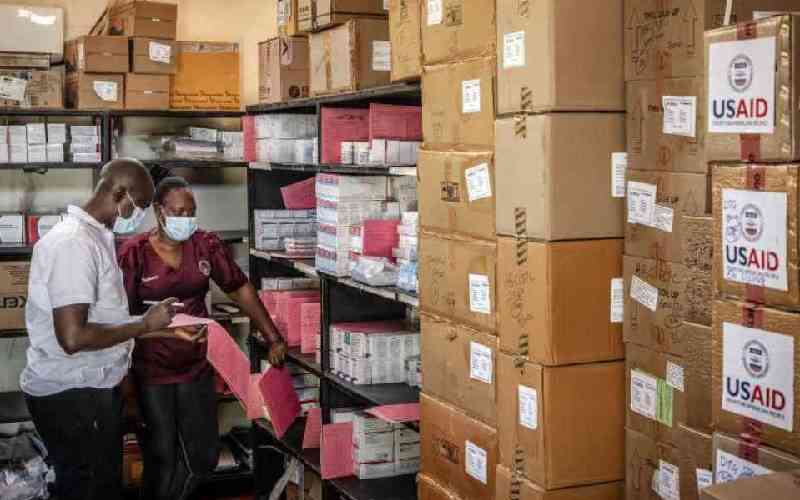
With the scrapping of USAID, which the Kenyan government highly depended on, a temporary bridge funding was set in place, meant to keep services running, and was set to end in March 2026.
Interventions for malaria, tuberculosis, and HIV/Aids, previously supported by USAID, remain uncertain amid stalled actualisation of the newly signed Sh322 billion US-Kenya health cooperation framework.
The Pepfar bridge funding was part of an earlier $1.6 billion (Sh 206 billion) package that the Kenyan government was set to receive from the US.
People living with HIV/Aids have expressed concern over possible stock-outs of essential medicines should the programmes remain suspended.
“Litigants should work out an alternative funding for HIV. Because today, for instance, if the Parliament approves emergency funding for HIV and TB, who will bother with the US Government deal? Posed the National Empowerment Network of People Living with HIV/Aids in Kenya, Executive Director Nelson Otwoma.
Otwoma added, “Why would they block what is coming but not consider an alternative?’
Initially, Kenya’s PEPFAR support was to end in September 2025, but was extended to December.
The new agreement has since been signed, but it is yet to be implemented, regardless of the bridge funding coming to an end by next month.
As the legal wrangles continue, other countries across Africa are implementing their respective framework.
Kenya was the first African country to sign, followed by Rwanda.
Beatrice Kairu, a health economist and public policy expert, has maintained that the court has not rejected health cooperation with the US, but reaffirms that large-scale health financing and data arrangements must comply with constitutional governance, fiscal discipline, and public trust.
“Policy certainty comes from strong processes, whereas weak processes create expensive policy failures,” Kairu told The Standard in an interview.
She observed that health funding that bypasses fiscal modelling and parliamentary scrutiny risks becoming unsustainable, and that sustainability is the fastest way to undermine Universal Health Coverage (UHC).
According to her, the court recognised that large health financing and data arrangements can cause irreversible harm if implemented without public participation, parliamentary oversight, and fiscal discipline.
“As a health economist, I see this pause as an opportunity to design a better, more legitimate, and more sustainable partnership, one that strengthens UHC without trading away governance, trust, or sovereignty,” she said.
But her statement was objected to by Ontowma, who said for 20 years, the American government has funded Kenyan health programs through PEPFAR, USAID, and Presidential Malaria Initiative, and there have never been any breaches.
“With a partnership agreement anchored on the country laws, there will be no breaches,” observed Otwoma.
He regretted that when the stop work order came into force, everyone went silent, even as the country faced stock out of HIV and TB medicines and vaccines for children.