

Audio By Vocalize

A group of Kenyans injured and those whose families were affected during the youth-led Gen Z protests has petitioned the Judiciary and Parliament over compensation.
They want the two institutions to urgently fast-track their compensation cases, saying they are sinking deeper into poverty and ill health as they wait for justice.
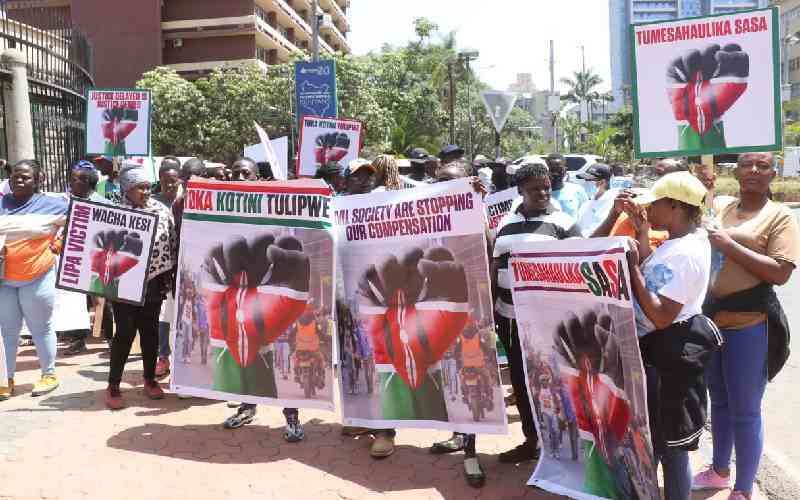
Speaking in emotional testimonies during a procession in Nairobi on Wednesday, the victims said years after the demonstrations, their lives remain shattered by gunshot wounds, broken limbs and psychological trauma.
Brian Chege, a casual construction worker, recounted how he was shot in the leg while collecting scrap metal in Githurai 45 on July 7, last year, during the Saba Saba protests.
“I was just hustling for scrap to feed my child. I heard gunshots and the next thing I knew, I had been shot in the leg,” he narrated at Uhuru Park before the group proceeded to present their petition to Parliament and the Supreme Court.
“If it were not for a Good Samaritan, I would not be alive today,” he added, breaking down into tears.
Though the bullet was removed and the bone repaired with metal implants, he said he has not fully recovered and can no longer work as a manual laborer.
“I am a mjengo man. I survive by lifting stones and mixing concrete. Now I cannot stand for long. I cannot carry anything heavy,” he said.
He further questioned: “How do I feed my child? How do I pay rent?”
Chege said that his struggles have been compounded by a lack of parents, with his relatives having long abandoned him.
“I have no mother, no father. I have no one to hold my hand,” he shared, saying that he now depends on well-wishers. “There are days I sleep hungry.”
“Sometimes we boil water and pretend it is soup so the children can sleep,” he added quietly. “All we are asking is for the government to compensate us so we can rebuild our lives.”

In a separate case, a Kawangware cobbler, Magdalene Naliaka, narrated how she witnessed the fatal shooting of her son during the June 2024 protests.
“We were trying to run when I heard a gunshot. My son was pushing a handcart from behind. He did not even look back,” she said. “The bullet hit him in the mouth. It exited through the back and died on the spot.”
The fairly-aged woman said she was later caught up in the melee, beaten and robbed as security officers dispersed protesters.
Stay informed. Subscribe to our newsletter
Her small shoe-repair stall was destroyed in the chaos, leaving her unable to provide for her children and those left by her departed son.
“My stall was my only source of income. It was brought down. Even my tools were taken. Now I cannot pay school fees. I cannot even buy medicine that doctors prescribed.”
One of his arms remains partially immobile.
“Look at this hand,” she said, overwhelmed by emotions even as she tried to lift her injured arm. “It cannot function properly. How do I work?”
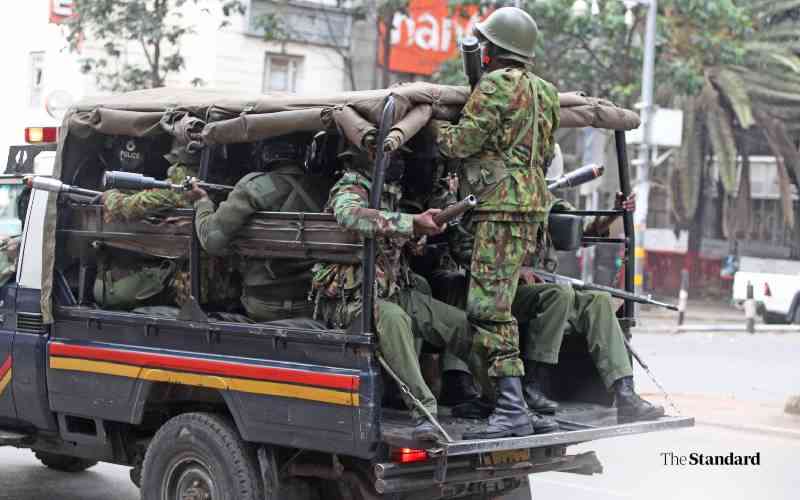
According to the Kenya National Commission on Human Rights (KNCHR), at least 100 people lost their lives in the chaotic protests and dozens of others were left nursing bullet injuries, with the deaths largely blamed on police excesses.
Following public outcry, President William Ruto formed a compensation panel to assess claims of injury, death and property loss linked to the protests.
However, victims say the process has been painfully slow.
“We filled forms. We submitted documents. We have appeared before officers,” said Chege. “But nothing has moved. Meanwhile, we are suffering.”
Through their petition, the group is asking the Judiciary to prioritise hearing related cases, accusing unnamed individuals of hijacking the process.
They also urged Parliament to allocate sufficient funds to the compensation fund to ensure timely and commensurate payments.
“There is a growing and dangerous perception among victims that brokers token kotini individuals and groups who thrive on endless cases are benefiting while victims continue to suffer,” said Dennis Wendo, Integrated Development Networks- Kenya’s National Coordinator, who led the issuance of the petitions.
“These court brokers and middlemen are not seeking justice for victims; they are prolonging cases for personal, political, or financial gain,” he alleged.
The petition was received by the Clerk of the National Assembly at Parliament Buildings and the Deputy Registrar, Supreme Court.
“We have agreed with your leader that he include the case numbers, the courts handling the cases and the name of those involved in the cases and resubmit to the Judiciary,” Bernard Kasavuli, Deputy Registrar of the Supreme Court, told the victims.