




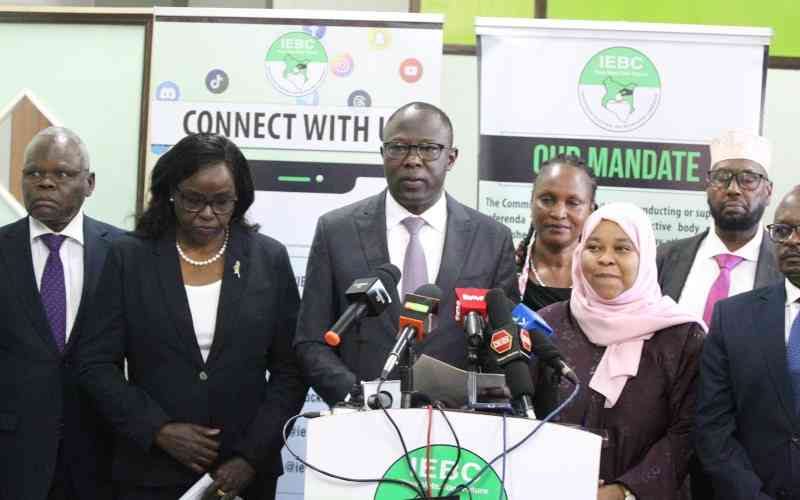
Independent Electoral and Boundaries Commission (IEBC) chairperson Erastus Ethekon has explained why the commission will not undertake a full boundary delimitation exercise ahead of the 2027 General Election.
Speaking on Tuesday, January 27, Ethekon cited time constraints, saying that the commission’s priority is preparations for the 2027 polls.
According to the chair, the Constitution requires boundary delimitation be conducted every eight to 12 years to review the names and boundaries of constituencies and wards. The last review was completed in 2012, with the next major review due by March 2024.
However, the process stalled after the 2022 General Election due to the absence of commissioners, making it impossible to undertake the exercise, Ethekon said.
“We have already exceeded constitutional timelines. The last review should have been completed by March 2024. In the absence of commissioners, the Secretariat had to pause the boundary review plan.”
He also pointed to ongoing court cases challenging the use of the 2019 census data, especially claims that the data for 14 out of 17 constituencies in Garissa, Wajir and Mandera counties failed to meet procedural standards.
“The matter is before the Court of Appeal, rendering the census data unusable for official purposes,” he said, noting that the data is critical in determining population quotas required for boundary delimitation.
“For the preliminary report and notice of intention to delimit boundaries, that census report is necessary. Until the matter is resolved, our work will remain hindered,” he added.
IEBC rules out changes to constituency and ward boundaries ahead of 2027 general election
Video by Jonah Onyango pic.twitter.com/uA1QHM1BbA
— The Standard Digital (@StandardKenya) January 27, 2026
The electoral agency chair further warned that delays in conducting the review have exposed IEBC to litigation, with cases filed seeking to compel the IEBC to undertake boundary delimitation before the 2027 elections. These litigations pose a risk depending on their outcome.
As a result, the commission has opted for a phased approach to boundary review to avoid compromising preparations for the 2027 polls.
The phased process will defer activities that rely on disputed census data while implementing those not affected by litigation, taking into account time and resource constraints.
According to the 2010 Constitution, Article 89 mandates the IEBC to delimit 290 constituencies and appropriate ward boundaries every eight to 12 years.
Stay informed. Subscribe to our newsletter
The law sets population quotas, allows deviations of up to 40 per cent for cities and sparsely populated areas, and 30 per cent for other areas, and requires public participation.
Any boundary review must be completed at least 12 months before a general election for the changes to take effect. If not concluded within this timeline, the changes cannot be applied to the upcoming polls.
According to Ethekon, the phased review is also not guaranteed to be completed, as it may be halted to focus on preparing for the 2027 polls, if need be.